In the era of modern technology, organizational security challenges have escalated to a point where traditional monitoring tools are no longer sufficient.
This article provides an in-depth analysis of the difference between AI SIEM and SIEM, exploring the critical necessity of shifting from passive monitoring to advanced, intelligent solutions.
By examining the capabilities of the indigenous Itroz platform, we demonstrate how artificial intelligence—through behavioral analysis and the reduction of false positives—effectively fortifies organizations against even the most complex cyberattacks.
This article is written by “Itroz” to provide an in-depth examination of the necessity to transition from passive monitoring systems to advanced and forward-thinking solutions.
In today’s world, where the rate of cyberattacks is increasing exponentially, traditional SIEM models are no longer capable of providing sustainable security on their own.
Utilizing an AI SIEM is not just a technical choice; it is a vital strategic imperative for organizations seeking rapid and precise responses to the most sophisticated attack vectors.
With the integration of artificial intelligence into the monitoring cycle, security has evolved from an error-prone human task into an automated, vigilant, and precise shield that defines the future of monitoring sensitive networks.
In fact, the core of the difference between AI SIEM and SIEM lies in the ability to perform contextual analysis of data.
Traditional systems are like vast libraries that merely record events, but intelligent platforms like Itroz act like expert analysts, evaluating every event within the context of past occurrences and ongoing behaviors.
This fundamental shift minimizes false positives—the greatest nightmare for modern security teams—and significantly boosts the ability to detect hidden threats.
In this analysis, we discover why previous generations of systems require a major upgrade to autonomous, self-learning platforms to ensure the survival of an organization’s digital assets.
One of the key aspects of the difference between AI SIEM and SIEM is the seamless handling of unknown threats and zero-day attacks.
Early tools relied solely on predefined identifiers and static signatures, which are utterly ineffective against today’s targeted attacks.
However, intelligent systems profile the organization’s actual, normal behavior, and by detecting the slightest deviation from this baseline, they sound the alarm before a disaster occurs.
This unparalleled flexibility in anomaly detection transforms the organization from a defensive posture to a vigilant one, permanently closing security gaps that remained hidden from rule-based, static methods.
First-generation systems revolutionized event logging by aggregating logs from various sources and keeping them in a unified repository.
The primary role of these devices was to meet compliance requirements and provide simple reports for auditing.
However, with the expansion of cloud environments and the overwhelming volume of logs, these systems collapsed under heavy processing loads.
Analysts would spend hours manually running queries to find clues of a hidden attack—a process during which the “golden time” for containing the breach was easily lost.
In contrast, today’s intelligent platforms use real-time processing and machine learning algorithms to instantly decode the content within events.
This approach combines raw data with global threat intelligence streams, creating a comprehensive and live view of the network’s status.
Instead of manually reviewing thousands of events, the system uncovers the connections between disparate incidents across different timeframes, mapping the entire attack chain for the security team.
This fundamental architectural upgrade elevates the overall efficiency of security operations centers (SOCs) to a level where threat hunting becomes a precise, proactive operation.
Comparing the efficiency of these two generations in data analysis marks a definitive shift from data archiving to “situational awareness.
”
Intelligent tools filter out all network noise and display only critical incidents that represent real risk.
As a result, the time to discover a breach is reduced from long intervals to mere seconds, playing a vital role in preserving assets.
This high capability ensures that sensitive assets remain protected, even during complex, multi-stage attacks.
Consequently, infrastructure monitoring has transformed from a tedious task into an intelligent process focused on real priorities.
The architecture of traditional platforms was built upon relational databases or static text-based storage structures.
In this framework, data was first received, normalized, and finally stored in a database for disk-based processing.
This time-consuming cycle caused severe latency during “log storms.
”
Scaling these platforms required heavy investment in hardware upgrades, yet the problem of the inability to analyze data content persisted.
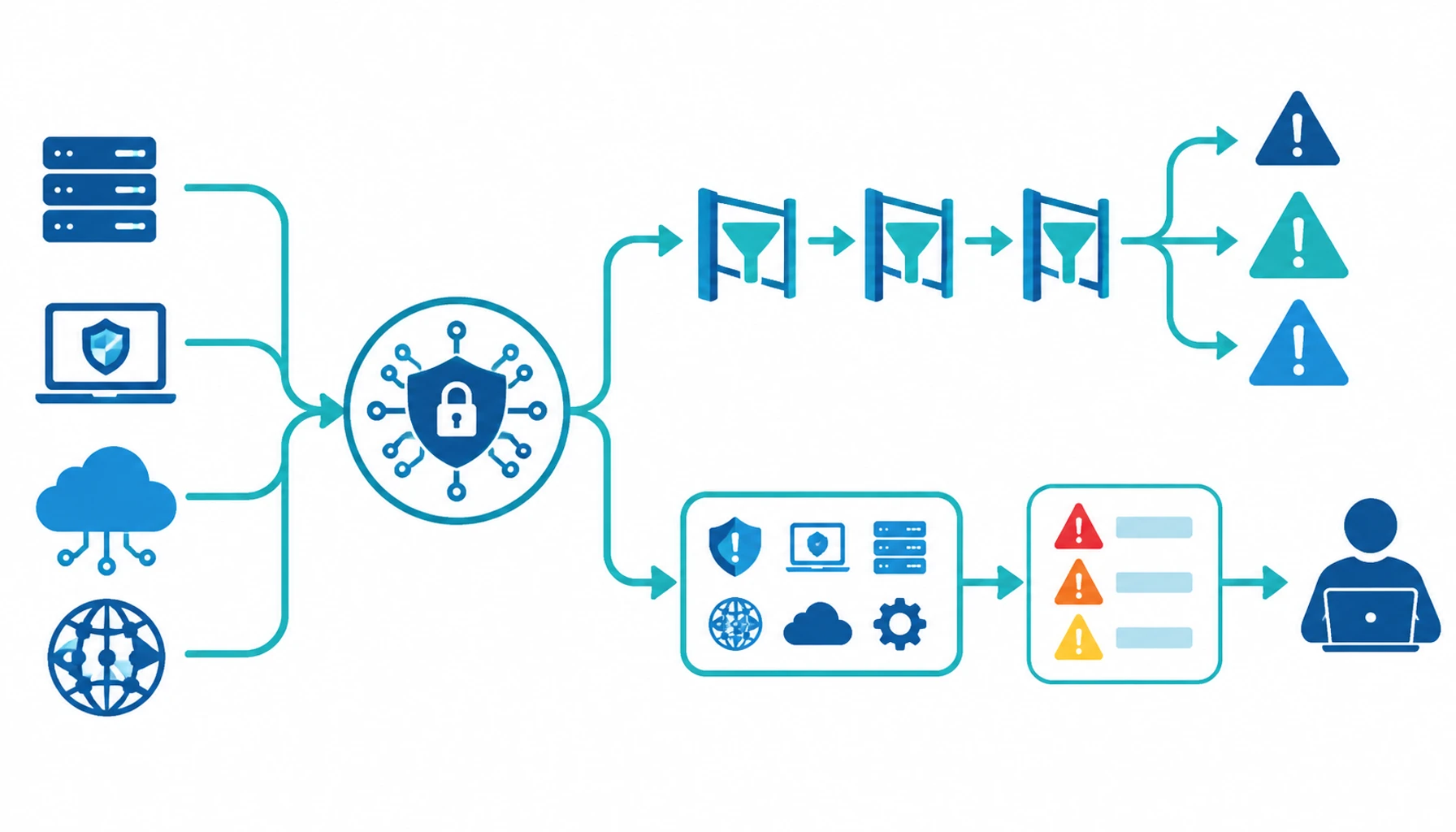
In modern platforms, a distributed architecture based on data streaming and parallel processing has replaced traditional infrastructure.
Data is processed in-memory immediately upon arrival, and behavioral patterns are analyzed before final storage.
These systems can handle massive scale and process millions of logs per second without any performance degradation.
The use of neural networks and machine learning has eliminated the need to manually define complex rules and has brought response speeds to optimal levels.
This architecture not only reduces maintenance costs but also realizes the potential for instant, seamless responsiveness.
Understanding the difference between AI SIEM and SIEM at the architectural layer helps managers allocate hardware budgets more intelligently.
Modern architecture, by accepting various unstructured data types, makes the integration of cloud systems and internal equipment much easier and creates the ability to adapt quickly to network changes.
This operational stability guarantees a continuous and uninterrupted stream of security monitoring at every moment.
When a system’s architecture is built on intelligent in-memory processing, past limitations disappear, and security monitoring is no longer a bottleneck, but a major business advantage.
Traditional security systems were dependent on human-defined rules.
If an attack did not match predefined signatures, the system would pass without showing any reaction.
Hackers easily bypassed these barriers by making minor changes to malware code and using obfuscation techniques.
Maintaining thousands of conflicting, outdated rules also became a serious problem; this complete reliance on manual rules left systems utterly powerless against the hidden movements of attackers.
The introduction of machine learning algorithms allowed systems to identify subtle behavioral changes in users and entities.
These systems learn the normal behavior of users, services, and ports over time, establishing a baseline of normalcy.
With the first unusual move—such as a login attempt at an odd hour or unauthorized access to sensitive files—the event risk score immediately increases.
Such capability paves the way for the precise detection of insider threats, data leaks, and lateral movement by attackers within the network.
The predictive power of these algorithms pushes an organization’s deterrence capability against advanced intrusions to its peak.
Combining deep learning models with environmental data has elevated detection accuracy to a level higher than human error.
With continuous risk assessment, decisions regarding blocking attacks occur with the highest confidence and minimal disruption.
New systems automatically evolve with the emergence of new attacker tactics and do not require constant rule rewriting.
This dynamic intelligence turns monitoring from a passive state into forward-looking defense.
Network stability against targeted attacks is dramatically strengthened thanks to this cognitive shield, and organizations can rely on this intelligence to remain resistant to even the most complex attacks.
he Itroz security platform, as an indigenous solution in the field of event management, utilizes advanced AI algorithms to completely fill the gaps found in traditional monitoring systems.
Focusing on deployment within the internal infrastructure of organizations, this product allows security teams to monitor all their digital assets in a secure and fully controlled environment.
The centralized architecture of this solution simplifies the complex process of log collection and analysis, offering a clear and unified view of the entire network’s security status.
The technology employed in this system, by intelligently analyzing user and entity behavior, operates beyond static rules and identifies the smallest anomalies in the deep layers of the network with stunning precision.
This solution is designed so that organizations, regardless of their level of infrastructure complexity, can benefit from its analytical capabilities to detect targeted attacks.
The Itroz technical team, by designing an architecture tailored to each organization’s specific needs, paves the way for implementation and integration in the simplest way possible for IT managers.
The main focus of this system is the early detection of threats and the reduction of data leakage risk, which becomes continuously smarter using machine learning.
Access management and monitoring of internal and external organizational activities have become core capabilities of this platform, which, alongside modern management dashboards, provides a powerful tool for immediate decision-making.
This indigenous approach, while fully complying with local standards, assures organizations that they benefit from a specialized solution and direct support, ensuring the organization’s information security is never compromised.
This intelligent solution goes beyond the simple task of data storage, performing comprehensive event analysis to uncover hidden malicious patterns.
By continuously examining the behaviors of users and systems, the system can easily identify activities that appear valid but have an abnormal nature.
This analytical power significantly reduces the risk of attackers exploiting legitimate user accounts to penetrate sensitive layers.
Itroz helps you discover and neutralize threats that remain completely hidden from traditional systems in the shortest possible time.
The Itroz product, by creating a single view of the security posture, eliminates information fragmentation across different organizational systems and frees analysts from tedious, manual reviews.
The AI algorithms in this system automatically extract security signals from millions of log records and convert them into reviewable cases.
This process ensures that security teams, instead of dealing with useless network noise, focus all their energy on countering real threats and implementing advanced defensive strategies.
Furthermore, the system has the capability to identify sudden changes in activity patterns, which is vital for the rapid detection of ransomware attacks and massive data leaks.
This platform, by performing contextual analysis of events, uncovers the links between disparate incidents across different timeframes and maps the complete attack chain for analysts.
This capability allows organizations to understand the attacker’s intent and take the necessary preventive measures in the shortest possible time.
With Itroz, you possess a security operations center that never sleeps and is always vigilant.
One of the main reasons for choosing this solution is its complete adaptability to the specific needs and infrastructure structure of each organization, which is directly managed by the Itroz technical team.
Unlike foreign tools that often come with exorbitant foreign currency costs and high implementation complexity, this product is designed with local requirements and specific access policies of Iranian organizations in mind.
Direct support and continuous guidance through the implementation path and technical updates minimize operational risks and guarantee the highest return on investment in the system.
The economic justification for this choice compared to foreign solutions is very evident, as in addition to reasonable costs, the expenses associated with maintaining complex hardware and the need for large operational teams are reduced.
The high precision of this platform in reducing false positives drastically decreases analyst burnout and prevents the waste of valuable human resources.
Organizations, by relying on this indigenous knowledge, maintain their full security independence and are completely freed from concerns regarding foreign dependencies and potential sanctions.
Finally, the focus on increasing network resilience against modern and complex attacks has made this solution a strategic option for maintaining business continuity.
Utilizing customizable algorithms ensures the platform grows with the evolution of cyber threats and becomes smarter over time.
Choosing Itroz is not just a product purchase, but joining a cycle of continuous security improvement that ensures the security of the organization’s information assets as a top priority and brings peace of mind to senior management.
Does the Itroz smart solution replace traditional SIEM?
Yes, by fully integrating SIEM capabilities and advanced artificial intelligence, this platform offers a comprehensive solution that covers all organizational monitoring needs with much higher precision.
Can the Itroz AI SIEM product be deployed in an internal data center?
Yes, this system is fully designed for On-Premise deployment so that the organization’s sensitive data remains entirely under your control.
Does AI in this solution really reduce false positives?
Definitely; by using intelligent behavioral patterns, the system, instead of reporting en masse, prioritizes only those events that are truly abnormal and eliminates noise.
Why should organizations choose the indigenous Itroz solution for their security?
Access to direct technical support, optimized costs, compliance with internal infrastructure, and security independence make this solution a superior choice for smart Iranian organizations.
Is it possible to customize algorithms for our specific infrastructure?
Yes, the Itroz technical team, after reviewing your infrastructure, customizes analytical algorithms for maximum precision and full compatibility with your business’s specific needs.
Source: Itroz
To post a comment, you must first log in to your account.